Data engineering and storage
The choice of ID format decides how many bytes every row, index entry, join key
and foreign key costs, how well columns compress, and whether files and index
pages can be skipped when you query by ID. This page measures those effects
rather than asserting them. Every number comes from scripts in
bench/storage/
that you can rerun on your own hardware.
What we measured
- PostgreSQL 18 primary keys
(
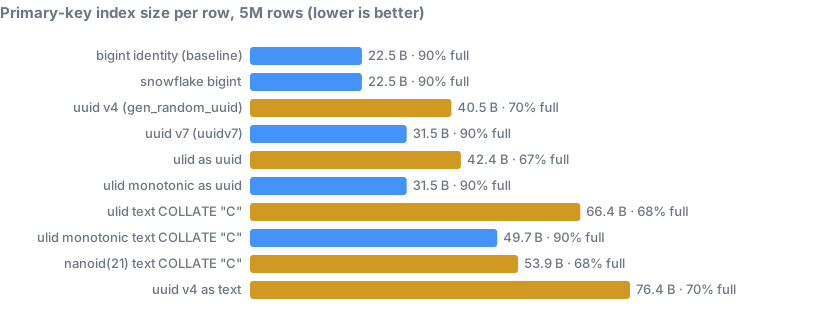
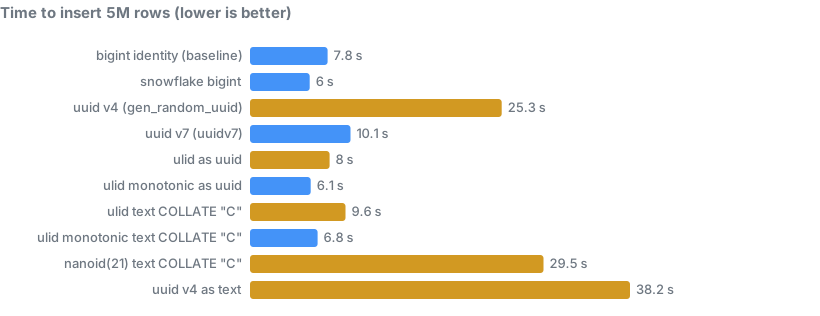
pg_storage.sh). For each ID type, a table(id <type> PRIMARY KEY, v int)gets 5,000,000 rows from oneINSERT ... SELECTafter aCHECKPOINT. We record insert time, heap and index size, B-tree leaf density frompgstattuple, and the WAL written. UUIDv4 and UUIDv7 use PostgreSQL’s owngen_random_uuid()anduuidv7(); the others use the idgenkit extension. - Column compression
(
compression.py). One million IDs per format are written in generation order, as a steady stream at 1,000 and at 100,000 IDs per second, all from the same synthetic clock. Each column is stored as fixed-width binary or ASCII and compressed with zlib and LZMA, as a stand-in for a columnar file with a general-purpose codec. Relative IDs belong to 1,000 keys (customer-0tocustomer-999), with each ID’s key picked at random, as rows from many customers arrive interleaved. They’re measured in that arrival order and again sorted by ID, which groups each key’s rows together. - Parquet encodings and row-group pruning
(
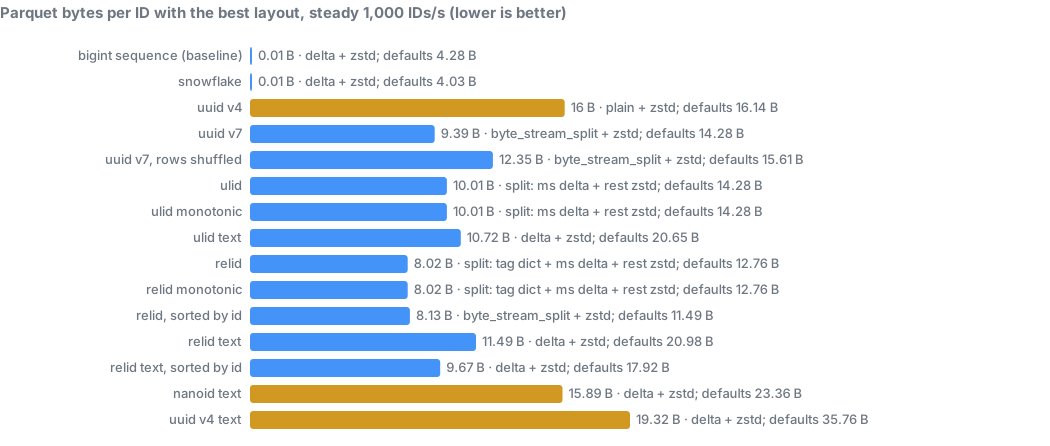
parquet.py). The same million-ID columns are written as real Parquet files with pyarrow 25.0.1, using pyarrow’s defaults and then the encodings Parquet offers for each physical type. Each column is also written in 100 row groups, and we count how many a point lookup must read once min/max statistics have ruled out the rest. For relative IDs we also count how many a scan for every ID of one key must read.
The runs used Docker on an Apple M-series Mac (4 CPUs, 6 GB for the VM) with
the default shared_buffers = 128MB. Absolute times will differ on your
hardware; the ratios between formats are what matter.
Results: PostgreSQL primary keys
| ID type | Insert 5M rows | Table | Index | Index per row | Leaf pages full | WAL |
|---|---|---|---|---|---|---|
bigint identity (baseline) |
7.8 s | 211 MB | 107 MB | 22.5 B | 90% | 676 MB |
Snowflake bigint |
6.0 s | 211 MB | 107 MB | 22.5 B | 90% | 661 MB |
UUIDv7 uuid (uuidv7()) |
10.1 s | 249 MB | 150 MB | 31.5 B | 90% | 743 MB |
ULID monotonic as uuid |
6.1 s | 249 MB | 150 MB | 31.5 B | 90% | 743 MB |
ULID (plain) as uuid |
8.0 s | 249 MB | 202 MB | 42.4 B | 67% | 796 MB |
UUIDv4 uuid (gen_random_uuid()) |
25.3 s | 249 MB | 193 MB | 40.5 B | 70% | 813 MB |
ULID monotonic text COLLATE "C" |
6.8 s | 287 MB | 237 MB | 49.7 B | 90% | 869 MB |
ULID (plain) text COLLATE "C" |
9.6 s | 287 MB | 317 MB | 66.4 B | 68% | 963 MB |
Nano ID text COLLATE "C" |
29.5 s | 287 MB | 257 MB | 53.9 B | 68% | 922 MB |
UUIDv4 as text |
38.2 s | 365 MB | 364 MB | 76.4 B | 70% | 1,132 MB |
Source: bench/results/storage-postgres18.txt, generated by bench/doc_tables.py.
What the numbers show
Order of arrival is what matters, not the format name. Each B-tree ended up in one of two states:
- In order (sequence, Snowflake, UUIDv7, monotonic ULID): new keys always go to the right-hand edge of the index. Full pages are left 90% full (PostgreSQL’s default fill factor), and the pages being written stay in memory.
- Out of order (UUIDv4, Nano ID, plain ULID): new keys land between existing ones. Pages split half-full, leaving about 70% average density, so the index is 28–34% larger for the same data.
Plain ULID is ordered between milliseconds but not within one. A bulk load
generates thousands of IDs per millisecond, and plain ULIDs within a millisecond
are in random order. The inserts still go to the recent end of the index, so
they’re fast (8.0 s), but the pages split as if the keys were random (67% full).
The monotonic generator fixes this completely: it matched uuidv7() exactly, at
150.4 MB and 90% full. PostgreSQL 18’s uuidv7() stays ordered because it adds
a sub-millisecond counter. RFC 9562 makes that counter optional, so check your
UUIDv7 library. At a few IDs per millisecond per generator, the difference
disappears.
Random keys are slow once the index outgrows memory. The UUIDv4 index (193
MB) is larger than shared_buffers (128 MB), so random inserts keep evicting
and re-reading pages. That’s why UUIDv4 took 2.5 times as long as UUIDv7.
Below that size the gap is much smaller; above it, and especially on disks
slower than a laptop SSD, it grows.
Binary beats text by a wide margin. The same ULID costs 31.5 index bytes
per row as uuid and 49.7 as text. UUIDv4 stored as text is the worst option
measured: 76.4 bytes per row, 1.9 times the uuid type, and 50% slower to
insert.
8-byte keys are the cheapest. Snowflake costs exactly what a bigint
sequence costs. It was slightly faster than the identity column here, most
likely because it skips PostgreSQL’s sequence machinery. Every UUID-sized key adds 9 bytes per
index entry and about 8 bytes per heap row (211 MB versus 249 MB), and the same
again for every foreign key and every secondary index that includes it.
WAL differences are modest in this test and larger in production. Random keys wrote 9% more WAL than UUIDv7 here. After each checkpoint, PostgreSQL logs a full image of every page the first time it’s modified. One bulk statement touches each page roughly once, which understates the effect. A steady OLTP workload with random keys modifies far more distinct pages between checkpoints than one with ordered keys, which shows up as more WAL, more replication traffic and larger backups.
MySQL’s InnoDB wasn’t measured here, but the effect is stronger there: the table itself is stored in primary-key order, so random keys fragment the table rows as well as the index.
Results: column compression
Bytes per ID after compression; lower is better. Highlighted cells still need 15 bytes or more per ID.
| Format | Raw | 1,000/s zlib | 1,000/s LZMA | 100,000/s zlib | 100,000/s LZMA |
|---|---|---|---|---|---|
bigint sequence (baseline) |
8 | 2.1 | 0.3 | 2.1 | 0.3 |
| Snowflake | 8 | 2.1 | 0.2 | 2.2 | 0.3 |
| UUIDv7, 16 bytes | 16 | 12.9 | 10.7 | 11.2 | 9.9 |
| ULID, 16 bytes | 16 | 13.0 | 10.9 | 12.1 | 10.4 |
| ULID monotonic, 16 bytes | 16 | 13.0 | 10.9 | 1.9 | 0.4 |
| ULID text, 26 chars | 26 | 13.4 | 11.3 | 12.4 | 10.9 |
| Relative ID, 16 bytes | 16 | 10.9 | 8.6 | 10.0 | 8.4 |
| Relative ID monotonic, 16 bytes | 16 | 10.9 | 8.7 | 4.6 | 1.8 |
| Relative ID sorted by ID, 16 bytes | 16 | 10.0 | 8.2 | 9.0 | 7.4 |
| Relative ID text, 28 chars | 28 | 12.6 | 8.8 | 11.3 | 8.6 |
| Relative ID text sorted by ID | 28 | 11.2 | 8.8 | 10.2 | 7.6 |
| UUIDv4, 16 bytes | 16 | 16.0 | 16.0 | 16.0 | 16.0 |
| Nano ID text, 21 chars | 21 | 15.9 | 16.1 | 15.9 | 16.1 |
| UUIDv4 text, 36 chars | 36 | 20.4 | 17.8 | 20.4 | 17.8 |
Source: bench/results/storage-compression.txt, generated by bench/doc_tables.py.
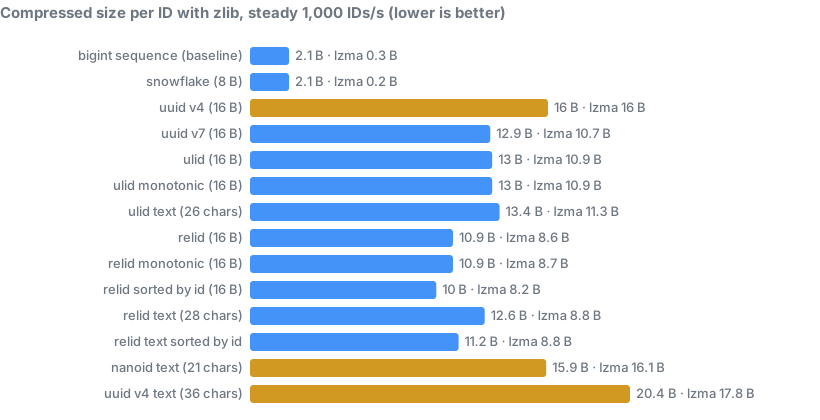
Randomness can’t be compressed. Each format’s floor is its random bits. UUIDv4 (122 bits) and Nano ID (126 bits) stay at about 16 bytes whatever the codec. Storing UUIDv4 as text only adds overhead, which compression removes again.
Time-ordered 128-bit IDs save about a third. UUIDv7 and ULID compress their 48-bit timestamp almost completely, but their 74 or 80 random bits (9–10 bytes) remain. That’s about 10–11 bytes per ID with LZMA.
Snowflake compresses like a sequence. Consecutive IDs differ only in their
low bits, so a Snowflake column costs 2 bytes per ID with zlib and under half a
byte with LZMA. Parquet’s DELTA_BINARY_PACKED encoding for INT64 columns
exploits the same property before any codec runs.
Monotonic ULID at high rates is a special case. At 100,000 IDs per second, 99% of monotonic ULIDs are the previous ID plus one, so the column compresses like a sequence (0.4 bytes). The flip side is predictability: within a millisecond, the next ID can be guessed from the previous one.
Relative IDs are the smallest 128-bit format. A relative ID has 50 random bits against ULID’s 80, and its 30-bit tag repeats for every ID of the same key. With 1,000 keys the tag carries only about 10 bits of information, so the floor is about 7.5 bytes and LZMA gets to 8.6 in arrival order, 2.3 bytes less than ULID. Sorting by ID brings the same tags together and saves a little more (8.2). A monotonic generator keeps one counter for all keys, so within a millisecond the random part only counts up. At 100,000 IDs per second that leaves mostly the tag’s 10 bits of key choice, and the column shrinks to 1.8 bytes.
Results: Parquet encodings
File bytes per ID at 1,000 IDs per second, with zstd level 3; lower is better. The floor is the format’s random bits divided by eight: no encoding can store a column in less. Bold marks layouts within 0.2 bytes of the floor. The last column shows how many of 100 row groups a lookup for one existing ID has to read after min/max pruning.
| Format | pyarrow defaults | Plain + zstd | Best layout | Floor | Row groups per lookup |
|---|---|---|---|---|---|
bigint sequence (baseline) |
4.28 | 1.03 | 0.01 delta | 0 | 1 |
Snowflake INT64 |
4.03 | 0.84 | 0.01 delta | about 0 | 1 |
| UUIDv7, 16 bytes | 14.28 | 12.14 | 9.39 byte stream split | 9.25 | 1 |
| UUIDv7, rows shuffled | 15.61 | 14.05 | 12.35 byte stream split | 9.25 | 100 |
| ULID, 16 bytes | 14.28 | 12.15 | 10.01 split column | 10 | 1 |
| ULID text, 26 chars | 20.65 | 12.87 | 10.72 delta | 10 | 1 |
| Relative ID, 16 bytes | 12.76 | 10.30 | 8.02 split columns | 7.5 | 99.9 |
| Relative ID, sorted by ID | 11.49 | 8.95 | 8.13 byte stream split | 7.5 | 1 |
| Relative ID text, 28 chars | 20.98 | 12.58 | 11.49 delta | 7.5 | 99.9 |
| Relative ID text, sorted by ID | 17.92 | 11.08 | 9.67 delta | 7.5 | 1 |
| UUIDv4, 16 bytes | 16.14 | 16.00 | 16.00 (nothing helps) | 15.25 | 100 |
| Nano ID text, 21 chars | 23.36 | 16.51 | 15.89 delta | 15.75 | 99.9 |
| UUIDv4 text, 36 chars | 35.76 | 20.55 | 19.32 delta | 15.25 | 99.9 |
Source: bench/results/storage-parquet.txt, generated by bench/doc_tables.py.
Monotonic ULID matches plain ULID at 1,000 IDs per second. At 100,000 IDs per second it drops to 0.29 bytes per ID with byte stream split, because nearly every ID is the previous one plus one.
The layouts are:
- Defaults: dictionary encoding with snappy compression, which is what pyarrow, and Spark with its default codec, write unless told otherwise.
- Plain + zstd: no dictionary, raw values, zstd.
- Delta:
DELTA_BINARY_PACKEDfor integers, which stores the differences between consecutive values;DELTA_BYTE_ARRAYfor strings, which stores the prefix each value shares with the previous one. - Byte stream split:
BYTE_STREAM_SPLITon the 16-byte column. It writes byte 0 of every value, then byte 1, and so on, so the slowly changing timestamp bytes sit next to each other and compress away. - Split column: the ID stored as two columns, the 48-bit millisecond
timestamp as a delta-encoded
INT64and the remaining 10 bytes raw. - Split columns (relative ID): three columns, the 30-bit tag as a
dictionary-encoded
INT32, the millisecond timestamp as a delta-encodedINT64and the 50 random bits as 7 raw bytes.
What the numbers show
The defaults are wrong for ID columns. Every value in a primary-key column is
unique, so a dictionary saves nothing: the writer builds one, gives up when it
grows too large, and falls back to plain values, and snappy barely compresses
them. Turning dictionaries off for ID columns and using zstd cut the file by 15%
for UUIDv7, 38% for ULID text and 76% for a sequence. This is a writer setting
(use_dictionary, compression in pyarrow; parquet.enable.dictionary and
spark.sql.parquet.compression.codec in Spark), not a change to the IDs.
Existing encodings already reach the floor. Byte stream split brings UUIDv7 to 9.39 bytes per ID, 1.5% above its 9.25-byte floor, and ULID to 10.03 against 10.0. What’s left is the random bits, which no encoding can shrink. An encoding designed for these formats could gain at most that last 1–2%. Byte stream split for fixed-length columns was added to the Parquet format in 2024, so check that every engine reading the files supports it before enabling it. The split-column layout gets the same result for ULID with encodings every reader supports. It also gives you a queryable millisecond column, but costs a little more for UUIDv7, whose fixed version bits stay in the raw part.
Integers are in a different league. Delta encoding stores a Snowflake or sequence column in 0.01 bytes per ID: a million IDs take about 10 KB. Real traffic is burstier than a steady synthetic stream, but the gap to any 128-bit format stays large.
Order matters as much as format. The same UUIDv7 values written in random row order take 12.35 bytes per ID instead of 9.39, and a lookup has to read all 100 row groups instead of one. Data arriving from many producers, or rewritten by a shuffle, is in that state until it’s sorted. Sorting by ID when writing, or with an Iceberg sort order or Delta Z-ordering, restores both the compression and the pruning.
Random IDs can’t be pruned by ID at all. Every row group of a UUIDv4 or Nano ID column spans nearly the whole value range, so min/max statistics never rule one out. Bloom filters, which Parquet also supports, are the tool for point lookups on those columns. We didn’t measure them.
Relative IDs need sorting to be pruned. In arrival order every row group holds IDs of nearly every key, and the tag is the top of the ID, so each row group’s min/max range covers almost everything. A lookup reads 99.9 of 100 row groups, and a scan for all IDs of one key reads all 100. Sorted by ID, a lookup reads 1 and a key scan 1.1, since each key’s IDs sit together. Split into three columns, arrival-order relative IDs take 8.02 bytes per ID, within 0.52 of the floor; the dictionary stores each of the 1,000 tags once. After sorting, byte stream split does slightly better (8.13 against 8.54 for the split columns), because the sort puts the tags in order but mixes up the timestamps. Text relative IDs compress well with delta encoding once sorted (9.67), since consecutive IDs share the tag as a prefix.
Can a new technique do better? Only by putting fewer random bits into each ID, since the measured layouts are already at the floor for the bits there are. Monotonic ULID and Snowflake are the two ways to do that here. So are designs like MongoDB’s ObjectId or TSID, where each process picks a random prefix once and then counts. The cost is that consecutive IDs from one generator become predictable, and uniqueness then depends on how many prefix bits there are. That’s a design trade-off, not an encoding trick.
What this means for data pipelines
Data skipping in Parquet, Iceberg and Delta
Columnar files keep minimum and maximum values per row group, page or file, and query engines skip files whose range can’t match a filter. When IDs are written in roughly time order, each file covers a narrow ID range, so filters and joins on recent IDs read only a few files. With UUIDv4 or Nano ID, every file spans nearly the full range and none can be skipped. This only helps if data is written, or sorted with Iceberg sort orders or Delta Z-ordering, in ID order.
Time is inside the ID
ULID, UUIDv7 and Snowflake carry their creation time to the millisecond, so you can:
- Scan by time without a timestamp index. In PostgreSQL:
WHERE id >= snowflake_from_timestamp(now() - interval '1 day'). - Recover the creation time in any language or in SQL with
ulid_timestamp()andsnowflake_timestamp(), which helps when debugging late or duplicated data. - Partition by ID range, so each range is also a time range.
Keep an explicit created_at column when the time matters to the business. The
ID holds the generator’s clock at millisecond precision, not the event time, and
generators with skewed clocks produce slightly out-of-order IDs.
Incremental loads and watermarks
WHERE id > :last_seen is an attractive incremental-extraction pattern with
time-ordered IDs, but it is only safe with a single generator and serialized
commits. With several writers, a row with a smaller ID can commit after you’ve
read past it, because of clock skew between generators or simply a slow
transaction. Either re-read a trailing window (for example the last few
minutes), or use change data capture (logical replication, Debezium) for
correctness.
Idempotent ingestion
Every format here except a database sequence can be generated by the producer,
before the write. Retries then carry the same ID, and duplicates are removed
downstream with a merge or ON CONFLICT DO NOTHING. Snowflake needs a unique
machine id per producer; the others need nothing.
Joins and memory
Hash joins, sort buffers and shuffles move keys around in memory. An 8-byte Snowflake key is half the size of a 16-byte UUID or ULID, and a third to a fifth of the size of 26–36-character strings, which also need string comparisons. On wide fact tables with several foreign keys, the key format can be a large share of the row.
Distributed and range-sharded stores
Time-ordered keys are ideal for a single-node B-tree and harmful for databases that split data by key range (Spanner, CockroachDB, TiDB, HBase and Bigtable row keys): every new row goes to the same range, and that node becomes a hotspot. Use random keys (UUIDv4, Nano ID), or prefix the ordered ID with a hash bucket. A relative ID already has such a prefix: its tag spreads writes for different keys across ranges, though every write for one busy key still goes to one range. Hash-partitioned systems (Kafka topics, Cassandra, DynamoDB) aren’t affected.
JSON and JavaScript
Snowflake IDs exceed 2⁵³, the largest integer JavaScript’s Number represents
exactly. Serialize them as strings in JSON and APIs. The other formats are
strings already.
How to store each type
| Platform | UUID (v4, v7) | ULID | Relative ID | Snowflake | Nano ID |
|---|---|---|---|---|---|
| PostgreSQL | uuid |
uuid via ulid_to_uuid(), or text COLLATE "C" |
text COLLATE "C" |
bigint |
text COLLATE "C" |
| MySQL | BINARY(16) via UUID_TO_BIN() |
BINARY(16) via ulid_to_bin() |
CHAR(28) with an ascii_bin collation |
BIGINT |
CHAR(21) with an ascii_bin collation |
| Parquet | FIXED_LEN_BYTE_ARRAY(16), UUID logical type |
FIXED_LEN_BYTE_ARRAY(16) or STRING |
FIXED_LEN_BYTE_ARRAY(16), sorted by ID |
INT64 |
STRING |
| Iceberg | uuid |
fixed[16] or string |
fixed[16] with a sort order on the ID |
long |
string |
| Spark, BigQuery | STRING or BINARY/BYTES (no UUID type) |
BINARY/BYTES or STRING |
BINARY/BYTES or STRING |
BIGINT / INT64 |
STRING |
| ClickHouse | UUID |
FixedString(16) or String |
FixedString(16) or String |
UInt64 |
String |
Prefer the binary forms for keys and convert to text only at the edges (APIs, logs, URLs). If a column must be text, use a byte-wise collation; locale-aware collations cost more and can change the sort order.
Limits of these measurements
- One machine, one PostgreSQL version and bulk single-statement inserts. OLTP traffic arrives in many small transactions; the ordered-versus-random gap persists, but the absolute numbers change.
- The Parquet test uses one writer (pyarrow), steady synthetic streams and single-column files. Other writers choose encodings differently, and we measured size and pruning only, not read or write speed, or Bloom filters.
- Lookups by a single ID aren’t shown. They’re similar for every format of the same byte width; smaller indexes need fewer page reads when the index doesn’t fit in memory.
Rerun everything with:
N=5000000 ./bench/storage/pg_storage.sh      # needs Docker
python3 bench/storage/compression.py 1000000
python3 -m venv build/bench-venv             # pyarrow, for the Parquet test only
build/bench-venv/bin/pip install -r bench/storage/requirements.txt
build/bench-venv/bin/python bench/storage/parquet.py 1000000
python3 bench/storage/charts.py              # redraws the charts on this page